

You are invited to Hack for Ageing Well

We are excited to announce Hack for Ageing Well, a two-day hackathon that we are organizing together with the Active and Assistive Living (AAL) programme, which will take place towards the end of September in St. Gallen.
Ageing Well means staying healthy, independent and active at work or in our community during our whole life. It is also a strategy in public policy around disease prevention and early detection, with better use of technology and better training towards a more supportive and accessible environment. We will set out to Hack: to rethink, sketch, prototype or build on existing technologies that – through more usable and considerate design – better support our later years.
Additional information can be found on the website, where you can register to get involved: https://2016.aalhackathon.eu/
Capacity is limited, so please book your (free) ticket if you are thinking of coming. We will soon have additional announcements of challenges and workshops for everyone who signs up!
We would appreciate suggestions if you have ideas of datasets or platforms, or would like to get your institution involved. This event is part of an international series, and we look forward to participants and datasets from around the world.
A collection of readings – by Barnaby Skinner
Dear friends & colleagues,
Dear Community,
I am currently attending a 3 month course at Columbia University in New York (together with Paul Ronga from Tribune de Genève and Mathias Born, Berner Zeitung). We are currently half way into the programme. It’s basically a course for journalists (but not just journalists), to enhance their data gathering, analytic skills (learning Python, Panda libraries, SQL, combining the three, scraping with BeautifulSoup and using Selenium for automated scraping, and much more).
I thought it would be a good moment to reach out to the community and share some of the readings and stories we’ve stubbled across. The main gist is that data driven society in the US may be a little more sophisticated than in Switzerland and Europe in general. But they are actually not all that far ahead. They are dealing with very similar problems and opportunities.
This is just a random collection of readings, which some of you might find inspirational or just offer a different perspective on data and how we deal with it.
Relational and Non-Relational Models in the Entextualization of Bureaucracy by Michael Castelle
http://computationalculture.net/article/relational-and-non-relational-models-in-the-entextualization-of-bureaucracy (a dry read at times, but very rewarding)
Literature is not Data: Against the Digital Humanities by Stephen Marche
https://lareviewofbooks.org/article/literature-is-not-data-against-digital-humanities
Machine Bias by Julia Angwin, Jeff Larson, Surya Mattu and Lauren Kirchner
https://www.propublica.org/article/machine-bias-risk-assessments-in-criminal-sentencing
How the Data Sausage Gets Made: A story about scraping food recalls and regular expressions
https://source.opennews.org/en-US/learning/how-sausage-gets-made/
How open data saved parkers in NYC millions of dollars
http://iquantny.tumblr.com/post/144197004989/the-nypd-was-systematically-ticketing-legally
NICAR-L mailing list
https://www.ire.org/resource-center/listservs/subscribe-nicar-l/
Hope you are all well and look forward to any feedback or comments anybody has on the readings.
Kind regards,
Barnaby
Opendata.ch/2016: Thank you for your participation!

The annual Opendata.ch/2016 conference took place on June 14 at the Casino de Montbenon in Lausanne and was a day of excellent exchange and mutual inspiration around topics of national and international importance. We want to thank everybody who made this conference so special: first and foremost, our amazing community, the fabulous speakers, supporting partners and generous sponsors. See the full programme and revisit the event through content curated here:
Opendata.ch/2016: The Excerpts
Quotes and impressions from the morning of the 2016 edition of the Opendata.ch conference. For all presentations and downloads click here.
Text by Martina Kammermann, photography by Nicolas Fojtu, licensed CC BY 4.0.
#people #machines #algorithms
«Imagine a machine that is a hundred times smarter than you. You wouldn’t feel comfortable if this machine would be controlled by just a small group.»
Marcel Salathé, Associate Professor at EPFL

Open source algorithm challenges mentioned: @crowd_ai
AI = Algorithm (come in – we’re OPEN) + data (sorry, we’re CLOSED) @marcelsalathe at #opendatach pic.twitter.com/EZQywfrNZB
— Hans Ulrich Wiedmer (@JohnWiedmer) June 14, 2016
#opensource #e-vote #transparency
“Realising open source is a daily internal struggle. There are very few people who know the subject, and it is very difficult for them to be understood. We need community.”
«Réaliser l’open source, c’est une lutte interne de tous les jours. Il y a très peu de gens qui connaissent la matière, et c’est très difficile de le faire comprendre. On a besoin d’une communauté.»
Anja Wyden Guelpa, chancelière d’Etat a Genève

Stand e-Voting Europe https://t.co/CJg6UASPft #opendata #opendatach
— Heiko Linke (@hlinke) June 14, 2016
#swiss #government #portal

“We will see soon new cantons on the portal. There will also be a user data requests forum.”
«On va voir des nouveaux cantons prochainement sur le portail. Il y a aura aussi un forum des souhaits pour des usagers.»
Jean-Luc Cochard, Bundesarchiv
Quelques statistiques sur l’utilisation d’https://t.co/sHCt9nEVSs. #opendatach #ogdch @Cochard_JL pic.twitter.com/o0wun4guGx
— Bundesarchiv (@CH_Bundesarchiv) June 14, 2016
#opendata #history #learning
“The hunter-gatherers have already picked the low-hanging fruit. We must create scalability.”
«Déjà les chasseurs-cueilleurs ont cueilli les fruits les plus accèssibles. Il faut créer des échelles.»
Simon Chignard, Auteur
Good memories! cc @golliez #opendatach pic.twitter.com/XgCRoR8zo5
— Stefan Oderbolz (@odi) June 14, 2016
#public #transport #openness
“The idea is to make as much data as possible public, including that which is not favorable to ourselves.”
«L’idée, c’est de rendre au public autant possible tous les données, compris celles qui ne nous sont pas favorable.»
Guillaume Leborgne, SNCF
Enjoying the talk of @guilleborgne about opendata @SNCF with a @liip smoothie! #opendatach pic.twitter.com/HsX41FItpL
— Jürg Hunziker (@tschortsch85) June 14, 2016
#govtech #business #process

«Open data is sustainable when it makes data production dramatically easier for the people, not harder.»
Joshua Goldstein, Department of Better Technology
“Open data works when it helps our society make sense of complex problems” from @african_minute at the #opendatach pic.twitter.com/Jw9OCrEFp0
— Opendata.ch (@OpendataCH) June 14, 2016
#civic #business #progress
«We are working on several reforms that will make startups that use government data more viable in the Ukraine. They should have tax reductions and many other privileges. And we are trying to persuade investors that these startups matter.»
Denis Gursky, 1991.vc
Reposted from blog.SODA.camp.
Opendata.ch/2016 Konferenz am 14. Juni in Lausanne!
Tickets are available on Eventbrite
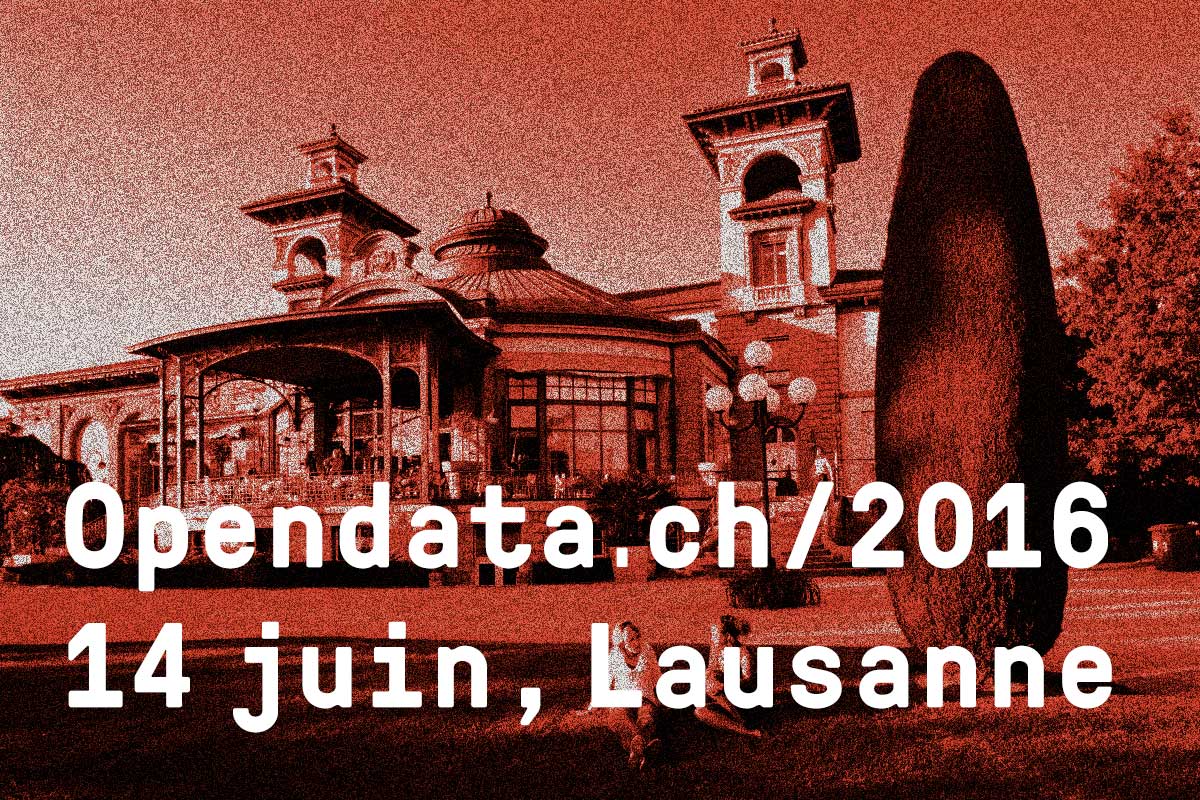
Opendata.ch/2016 is Switzerland’s leading event convened around the issues of Open Data. This year will see a more diverse, dynamic, brighter and better Open Data Conference than ever before. Join us on June 14 at the Casino de Montbenon (Allée Ernest-Ansermet 3) in Lausanne to shape the national conversation among business executives, politicians, public officals, researchers and open data enthusiasts from all over Switzerland through a program that includes (among others):
9:00 Café & Croissants (Foyer)
09:30am: Welcoming Speech by Nuria Gorrite (fr)
Nuria Gorrite, Conseillère d’Etat (VD, parti socialiste), précédemment syndique de Morges. Responsable du Département des infrastructures et des ressources humaines (services: mobilité et routes, accueil de jour des enfants, systèmes d’information, personnel de l’Etat, développement durable, information sur le territoire, opérations foncières).
 09:40am: Keynote by Marcel Salathé (en)
«Data of the people, by the people, for the people»
Marcel Salathé is Associate Professor at EPFL in the Schools of Life Sciences and Computer & Communication Sciences. After a PhD at ETH Zürich, he went to Stanford University as a Branco Weiss Fellow. There, he contributed to the emerging field of “Digital Epidemiology”, and in 2010 became Assistant Professor at Penn State University. His work leverages novel digital data streams by analyzing big data sets from online sources through machine learning.
 10:00am: Keynote by Denis Gursky (en)
«Promoting Open Data in Ukraine for socially meaningful IT-projects»
CEO and Founder of Socialboost – a tech NGO that promotes innovative instruments in order to improve civic engagement and make government more digitalized — thus accountable, transparent and open.
 10:20am: Keynote by Anja Wyden Guelpa (fr)
«Open source – un chemin vers la transparence et la confiance en matière de vote électronique ?»
Anja Wyden Guelpa a été la première femme élue chancelière d’Etat à Genève en 2009 et réélue en 2013 pour un deuxième mandat.
Elle préside la collège des secrétaires généraux des départements de l’Etat de GE et est membre du conseil d’administration de Suisse Tourisme et du conseil régional de la RTSR.
 10:40am: Keynote by Jean-Luc Cochard (fr)
«Opendata.swiss ! Et après ?»
Cochard est le Chef Unité des techniques de l’information au Département fédéral de l’intérieur DFI aux Archives fédérales suisses AFS
11:00 Networking Break (Foyer)
 11:20am: Keynote by Simon Chignard (fr)
«5 ans d’open data: qu’avons-nous appris?»
Simon Chignard est Data Editor au sein de la mission Etalab, le service du Premier ministre français en charge de l’ouverture des données publiques (data.gouv.fr). Avant de rejoindre Etalab, il a accompagné depuis 2011 des acteurs publics (collectivités) et privés, en France et en Suisse, dans la valorisation de leurs données. Il est l’auteur de deux ouvrages: «Open Data» (Fyp Editions 2012) et «Datanomics» (avec Louis-David Benyayer, Fyp Editions 2015) et tient le blog donneesouvertes.info.
 11:40am: Keynote by Guillaume Leborgne (fr)
«SNCF, la politique ouverture des données d’une grande entreprise publique»
Guillaume LEBORGNE, Directeur du programme transparence et de l’open data SNCF. Il travaille depuis 2014 à l’ouverture et à la diffusion des données de SNCF (chemins de fer français) dans une volonté de transparence. En deux ans, il a fait passer l’Open data SNCF de 18 à 82 jeux de données ouverts. Ce diplômé de Sciences-po Lille et du Celsa a auparavant passé une importante partie de sa carrière dans la presse. Comme rédacteur en chef de Ville Rail et Transports, il a notamment été à l’origine de la création du Palmarès des Régions, qui compare tous les ans les données ferroviaires des Régions Françaises.
 12:00am: Keynote by Joshua Goldstein (en)
«What does a Department of Better Technology do?»
CEO of the Department of Better Technology (DOBT)
Goldstein is CEO of the Department of Better Technology (DOBT), a software company that helps governments deliver digital services to the people that depend on them. In the United States, DOBT serves federal agencies (USAID, State Department), states (California Department of Justice) and cities (Philadelphia, San Francisco). In Europe, DOBT is proud to partner with Liip to serve the Swiss Government. In his spare time, Josh is completing a PhD at Princeton University where he is affiliated Center for Information Technology Policy.
12:20am: Introducing the afternoon workshops
We thank our partner EPFL and our sponsors Liip, opendata.swiss, Hasler Stiftung, esri Suisse, Begasoft, Schweizer Informatik Gesellschaft, nine.ch and Mediaktion for their tremendous support in realizing the Opendata.ch/2016 conference.
P.S. Please note that the keynotes will be held in french and english language.
